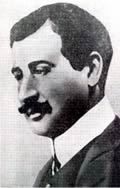
8 Published BooksDaniel Varujan
Daniel Varujan (Armenian: Դանիէլ Վարուժան, April 20, 1884-August 26, 1915) is one of the significant Armenian poets of the XX century.Taniel Varoujan was one of the greatest Armenian poets of this century. At the age of 31, when he was blossoming to become a poet of international stature, he was brutally murdered (see below) by the government of "The Young Turks", like Siamanto, Zohrab and many others, as part of the officially planned and executed Genocide of the whole Armenian nation. Varoujan was born in the Prknig village of Sivas, Turkey. After attending the local school, he was sent in 1896, the year of the Hamidian massacres, to Istanbul, where he attended the Mkhitarian school. He then continued his education at Mourad-Rafaelian school of Venice, and in 1905 entered the university of Ghent in Belgium, where he followed courses in literature, sociology and economics. In 1909 he returned to his village where he taught for three years. After his marriage in 1912, he became the principal of St. Gregory The Illuminator School in Istanbul.
In 1914, Taniel Varoujan established the "Mehian" literary group and magazine with Gosdan Zarian, Hagop Oshagan, Aharon and Kegham Parseghian. The purpose of this movement was to start an Armenian Renaissance, to wake the nation up from centuries of slavery and darkness, to reconnect it to its great Pre-Christian past ("Mehian" means temple), and to encourage it to stand up on its own feet and not tolerate any tyranny, whether from its own corrupt leadership or the Turkish government. The fundamental ideology of Mehian was expressed as:
"We announce the worship and the expression of the Armenian spirit, because the Armenian spirit is alive, but appears occasionally. We say: Without the Armenian spirit there is no Armenian literature and Armenian artist. Every true artist expresses only his own race's spirit...We say: External factors, acquired customs, foreign influences, diverted and deformed emotions have dominated the Armenian spirit, but were unable to assimilate it."
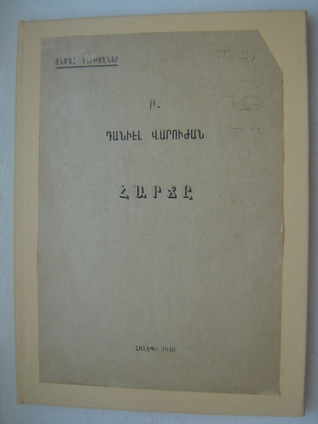
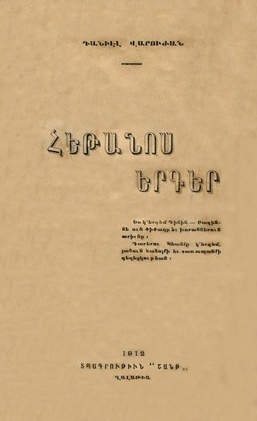
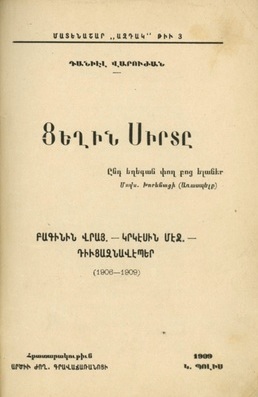
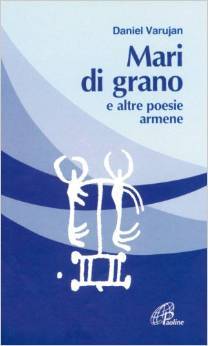
Varoujan has produced four great volumes of poetry: SHIVERS (1906), THE HEART OF THE RACE (1909), PAGAN SONGS (1912), and THE SONG OF THE BREAD (1921). The last book is an unfinished manuscript which was saved by bribing Turkish officials. An eyewitness* has narrated the torture and martyrdom of Taniel Varoujan, Roupen Sevag (another great Armenian writer), and three others. After being arrested and jailed, they were told that they were being taken to a village. On the way, a Turkish official and his assistant, accompanied by five "policemen" who were armed to the teeth, stopped the convoy. After robbing the five prisoners, the first two who were in charge left and ordered the other five to take them away. After taking them to the woods, they attacked the prisoners, took off their clothes until all of them were completely naked. Then they tied them one by one to the trees and started cutting them slowly with their knives. Their screams could be heard from a long distance where this eyewitness was hiding. One of his great works The Songs of Bread (Hatsin Yerge)a fifty page collection of poems, was confiscated during the genocide. It was later published posthumously in 1921. The poems celebrate the simple majesty of village agricultural life, celebrating the Armenian peasant of Anatolia. More then anyone else of their time, Siamanto and Varoujan verbalized the hopes of the Armenians at the turn of the century. Using legends, old epics, and pagan history at the springboard and allegory for their aspirations, they waited for deliverance from oppression and the rebirth in Armenian arts.